
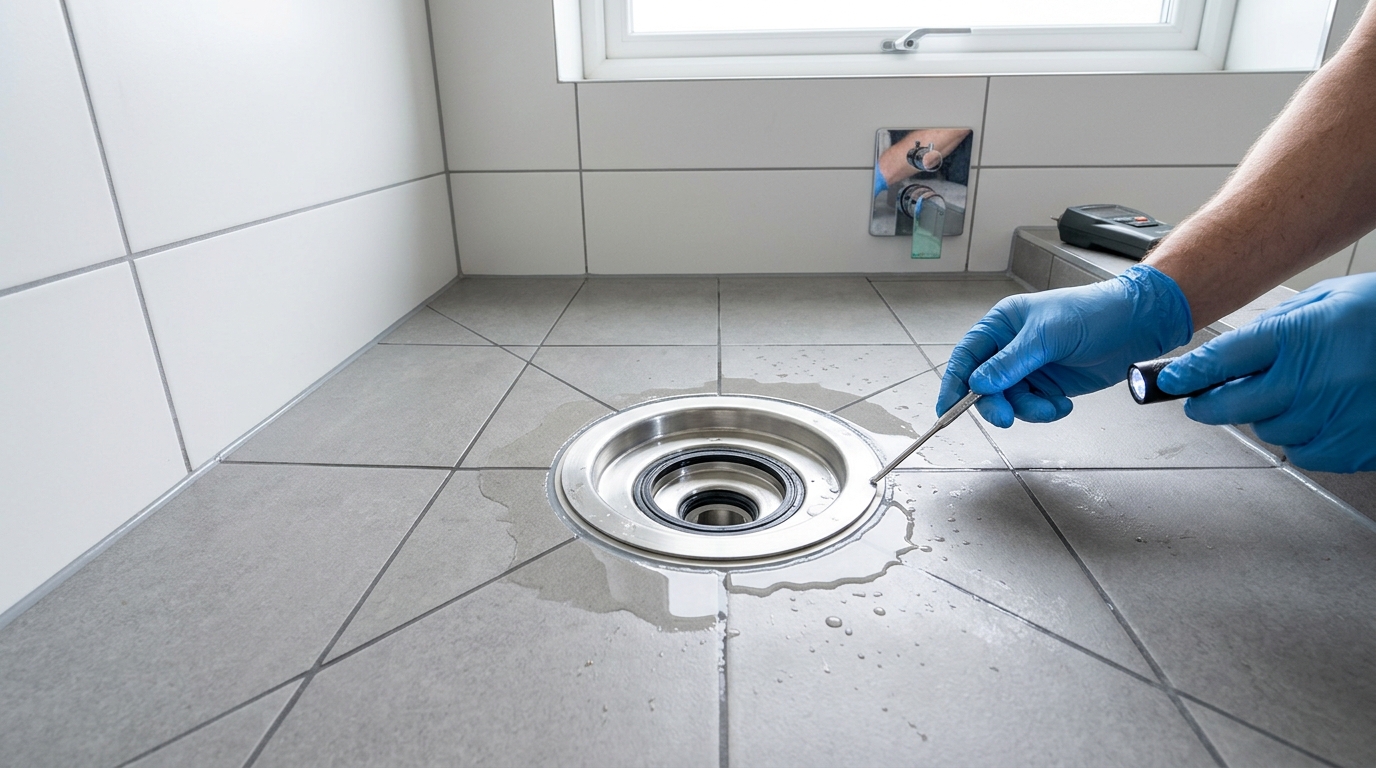
Non-invasive bathroom inspection focusing on floor drain trap collars and waterproof epoxy tile joints
1. Why Demolition Is Often Unnecessary
Historically, the only solution suggested by masonry contractors was to smash all bathroom floor and skirting tiles, dig out the sunken slab filling, replace the waterproofing layer, and retile everything. This approach creates ten to fifteen days of unbearable noise, dust, sanitary dislocation, and thousands of rupees in replacement tile expenses.
Today, diagnostic plumbing testing and high-performance polymer chemicals allow skilled contractors to target the exact pathway of water without disturbing your ceramic tiles.
2. First Diagnostic Step: Rule Out Active Pipe Fractures
Before touching any tile grout, the contractor must determine whether the leak is continuous or intermittent:
- Continuous Water Drip: If water drips steadily 24 hours a day even when nobody has used the shower, it strongly indicates a fracture in a pressurized concealed CPVC, GI, or PPR water supply pipe. In this situation, the contractor connects a pressure testing gauge to isolate which line has a drop in bars.
- Intermittent Water Drip: If the dripping or dampness only appears 30 to 90 minutes after someone takes a bath or cleans the floor, the cause is tile joint erosion, waste trap collar leakage, or sunken slab drainage failure.
3. The Non-Invasive 3-Step Treatment Protocol
- High-Performance Two-Part Epoxy Regrouting: Ordinary cement grout dissolves over time due to acidic toilet cleaners. Contractors mechanically grind out the old cement grout, clean the joint grooves with industrial dryers, and fill all floor and wall tile joints with waterproof, chemical-resistant two-part epoxy resin.
- Waste Pipe Nahani Trap Collar Casting: Up to 50% of bathroom leaks happen where the PVC floor drain trap penetrates the concrete slab. Contractors dismantle the drain grating, inject a hydrophilic sealing ring, and cast an elastomeric chemical collar directly inside the sleeve.
- Polyurethane (PU) Pressure Injection Grouting: In stubborn cases where water has saturated the sunken slab filling, small 10mm injection ports (packers) are installed. Expanding polyurethane resin is pumped under low pressure. The resin seeks out internal water channels, expanding to form a permanent flexible gasket that blocks moisture travel.
Need A Bathroom Leakage Diagnosis?
Submit an enquiry to get connected with independent bathroom waterproofing specialists in your Gujarat city.
Request Free Inspection